
Are Electronic Signatures Legally Valid in India?
Disclaimer: The information provided in this article is for educational purposes only and does not constitute legal advice. Please consult a qualified legal professional regarding your specific compliance requirements.
With the rapid growth of remote work and digital business processes, the era of printing, signing, scanning, and mailing physical contracts is quickly fading. Modern Indian enterprises rely heavily on online document signing to accelerate deals.
However, before adopting paperless workflows, every business owner, HR team, and freelancer asks the same critical question: Are electronic signatures legally valid in India?
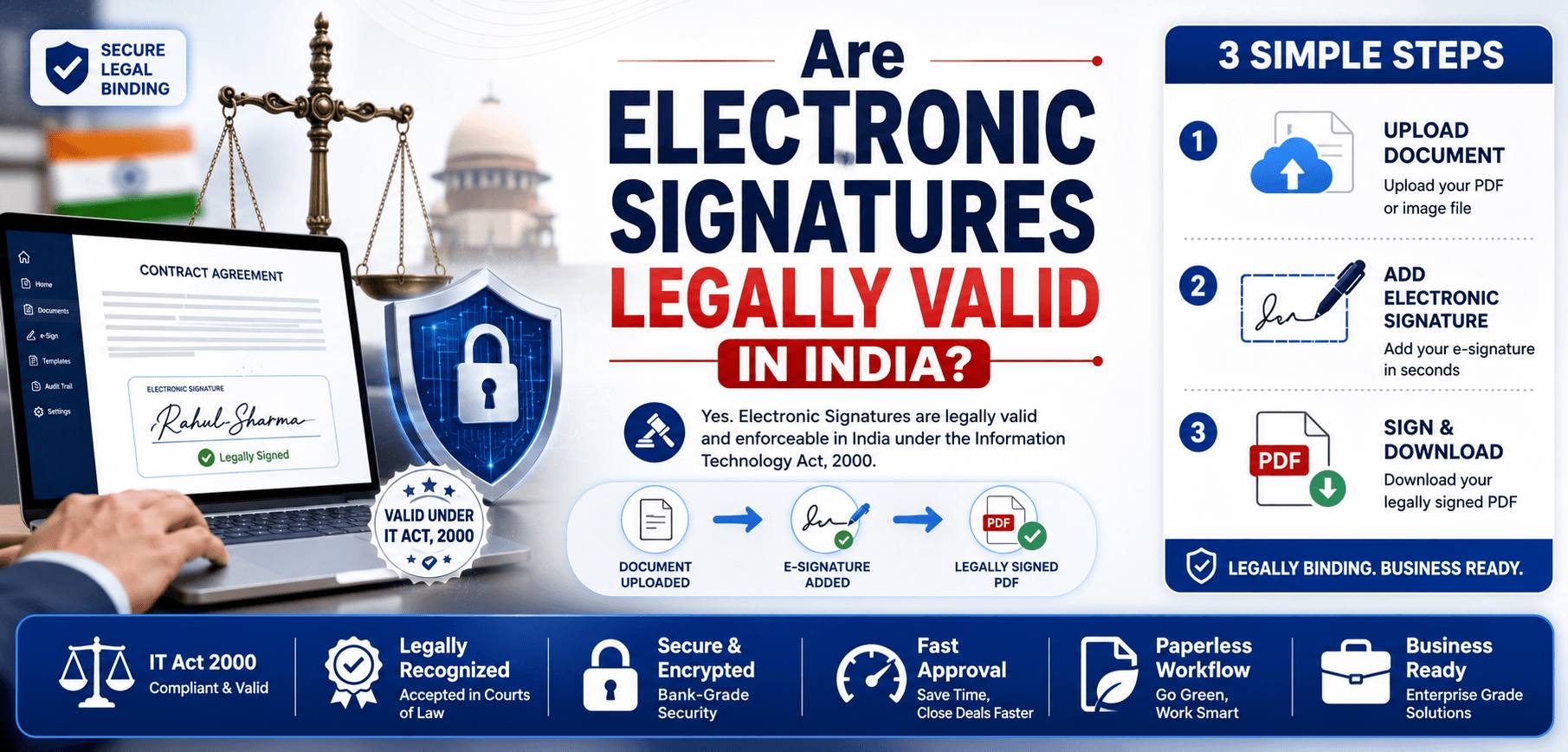
The brief answer is Yes. Electronic signatures are legally recognized and enforceable in India, provided they meet specific criteria outlined under Indian law. In this comprehensive guide, we will break down the legal framework, the different types of valid signatures, and how you can safely use platforms like AllPDFTools to e-sign documents.
What Is an Electronic Signature?
An electronic signature (or e-signature) refers to any electronic data attached to or logically associated with other electronic data (like a PDF contract) which serves as a method of authentication. It demonstrates the signer's intent to agree to the document's contents.
Unlike a handwritten "wet ink" signature, electronic signatures come in various forms:
- Typed signatures: Typing your name at the bottom of an email or contract.
- Drawn signatures: Using a mouse or stylus to draw your signature on a screen.
- Click-to-sign: Clicking an "I Agree" or "Accept" button.
- Aadhaar-based eSign: An authenticated digital signature linked to an individual's Aadhaar framework.
- Digital signatures: A highly secure, encrypted form of electronic signature requiring a specific certificate.
Electronic Signature vs Digital Signature
While often used interchangeably, electronic signatures and digital signatures are legally and technically different in India.
| Feature | Electronic Signature | Digital Signature (DSC) |
|---|---|---|
| Purpose | Shows intent to sign a document. | Cryptographically secures and validates identity. |
| Security Level | Standard security (Audit trails, IP tracking). | High security (Encryption, PKI technology). |
| Legal Framework | Recognized under Contract Act & IT Act Section 3A. | Explicitly defined and protected under IT Act Section 3. |
| Verification Method | Email authentication, SMS OTP, visual verification. | Issued by Certifying Authorities (CAs) using a USB token. |
| Typical Use Cases | NDAs, HR documents, sales contracts, proposals. | Govt tenders, tax filings, MCA filings. |
Every digital signature is an electronic signature, but not every electronic signature is a digital signature.
Are Electronic Signatures Legal in India?
Yes. The legality of electronic signatures in India is primarily established by the Information Technology (IT) Act, 2000. The Act provides legal recognition to electronic records and establishes that a contract cannot be denied enforceability simply because it is in an electronic format.
For an electronic signature to be considered legally valid and enforceable, it generally must satisfy three conditions:
- Reliability: The signature creation data must be linked exclusively to the signatory.
- Authentication: Any alteration to the signature or the document after signing must be detectable.
- Consent: The signatory must have clearly intended to sign the document.
Laws Governing Electronic Signatures in India
Information Technology Act, 2000
The IT Act is the foundational law for digital India. Section 5 grants explicit legal recognition to electronic signatures, stating that if a law requires a signature, an electronic signature satisfies that rule.
Indian Evidence Act, 1872
Under Sections 65A and 65B of the Evidence Act, electronic records are admissible as evidence in Indian courts. If you sign a PDF online, that digital file can be presented to a judge just like a physical contract.
Indian Contract Act, 1872
The Contract Act recognizes oral, written, and implied contracts. Therefore, electronic contracts in India formed via email exchanges or click-wrap agreements are valid, provided there is an offer, acceptance, and lawful consideration.
What Types of Electronic Signatures Are Valid in India?
The Indian legal system broadly accepts three categories of electronic signatures:
- Aadhaar eSign: An online electronic signature service integrated with an individual's Aadhaar profile. It is a highly secure, government-backed method considered legally equivalent to a handwritten signature.
- Digital Signature Certificates (DSC): USB-token-based signatures issued by licensed Certifying Authorities. These hold the highest presumption of validity in court.
- Authenticated Electronic Signatures: Standard e-signatures (like drawing your signature on an E-Sign PDF Tool) combined with strong audit trails, email verification, and IP logging. These are perfectly valid for most B2B and B2C contracts.
Documents That Can Be Signed Electronically
The vast majority of day-to-day business documents can and should be signed electronically. Examples include:
- Employment agreements
- Vendor and supplier contracts
- Service Level Agreements (SLAs)
- Non-disclosure agreements (NDAs)
- Purchase orders and invoices
- Business proposals
- Software licenses
- Internal HR approvals
Exceptions: Documents That May Require Additional Legal Formalities
The First Schedule of the IT Act explicitly states that the Act's electronic signature provisions do not apply to certain documents. These must typically be executed on physical paper with wet-ink signatures:
- Negotiable instruments (e.g., Promissory notes, Cheques)
- Power of Attorney (PoA)
- Trust deeds
- Wills and testamentary documents
- Certain real estate contracts and property sale deeds
Always consult legal counsel before executing highly sensitive statutory documents electronically.
Benefits of Electronic Signatures
- Faster approvals: Reduce turnaround time from weeks to minutes.
- Remote signing: Sign documents from any device, anywhere in India or the world.
- Reduced paperwork: Lower printing, courier, and physical storage costs.
- Better document management: Digital files are easier to search, organize, and back up.
- Improved business efficiency: Automate document routing and free up HR and legal teams.
How Electronic Signatures Improve Business Workflows
HR Onboarding
Candidates sign offer letters and company policies digitally via their smartphone, ensuring a seamless candidate experience.
Vendor Management
Procurement teams can execute NDAs and vendor agreements instantly, preventing supply chain delays.
Client Contracts
Sales teams can close deals faster by allowing clients to "click-to-sign" business proposals rather than printing and scanning them.
Compliance Processes
Internal audits and policy acknowledgments are tracked automatically with secure digital audit trails.
Security Features of Modern E-Signatures
To ensure legal validity in Indian courts, modern e-signature platforms employ robust security features:
- Audit trails: A comprehensive log tracking who viewed, signed, and downloaded the document.
- Identity verification: Capturing the signer's email, IP address, and browser data.
- Encryption: Securing the document data while in transit and at rest.
- Timestamping: Cryptographically recording the exact Indian Standard Time (IST) of the signature.
- Tamper detection: Invalidating the signature if the PDF is modified after signing.
Electronic Signatures and PDF Documents
The PDF (Portable Document Format) is the global standard for electronic contracts because it reliably preserves formatting. By using an E-Sign PDF Tool, you can securely apply your signature over the document's text layer.
Platforms like AllPDFTools allow you to quickly convert Word documents to PDFs, draw or type your signature, and share the finalized, tamper-evident file—all within your web browser.
Best Practices for Legally Safe E-Signing
- Verify signer identity: Send contracts to verified corporate email addresses rather than generic personal accounts.
- Maintain audit records: Always keep the digital certificate or audit log associated with the signed PDF.
- Use trusted e-sign platforms: Ensure the software complies with basic IT Act security standards.
- Store signed documents securely: Keep backups in encrypted cloud storage.
- Obtain clear consent: Include a clause in the contract stating that both parties agree to execute the document electronically.
- Keep document version history: Ensure the final signed version is easily distinguishable from earlier drafts.
Common Myths About Electronic Signatures
Myth: "Electronic signatures are not legal."
Reality: The IT Act explicitly legalizes electronic signatures for most commercial contracts.
Myth: "Only digital signatures (DSC) are valid."
Reality: While DSCs have higher evidentiary value, standard authenticated e-signatures are completely valid and legally binding for standard agreements.
Myth: "Courts never accept electronically signed documents."
Reality: Indian courts routinely accept electronic records under Sections 65A/65B of the Evidence Act, provided they meet authentication requirements.
Future of Electronic Signatures in India (2026 and Beyond)
As the Digital India initiative continues to expand in 2026, paperless workflows are becoming the default. We expect to see increased integration of AI-assisted document verification, widespread adoption of Aadhaar eSign across the private sector, and the growth of e-governance services that rely entirely on secure digital contracting.
Frequently Asked Questions (FAQs)
1. Are electronic signatures legally valid in India?
Yes. Electronic signatures are legally valid and enforceable for most commercial contracts under the Information Technology Act, 2000.
2. What law governs electronic signatures in India?
The primary laws are the Information Technology Act, 2000, the Indian Contract Act, 1872, and the Indian Evidence Act, 1872.
3. Is an Aadhaar eSign legally valid?
Yes, Aadhaar eSign is a highly secure, legally recognized electronic signature service integrated with the government's Aadhaar framework.
4. What is the difference between an electronic signature and a digital signature?
An electronic signature shows intent to sign (like drawing your name), while a digital signature uses cryptographic encryption (like a USB token) to guarantee high-level security and identity verification.
5. Can electronically signed contracts be enforced in court?
Yes. Electronically signed contracts are admissible as evidence in Indian courts, provided the signature and document can be properly authenticated.
6. Are electronically signed PDFs valid?
Yes. A PDF signed using a secure e-signature platform that generates an audit trail is a legally valid electronic record.
7. Which documents cannot always be signed electronically?
Wills, power of attorney, trust deeds, negotiable instruments, and real estate sale deeds generally require physical, handwritten signatures in India.
8. How can businesses securely use e-signatures?
Businesses should use trusted platforms like AllPDFTools to sign documents, ensure emails are verified, and maintain clear digital audit trails for every transaction.
Conclusion
If your business is still printing and courier-mailing contracts, it's time to upgrade. Legally valid electronic signatures are fully supported by Indian law under the IT Act 2000. While a few specific documents still require physical ink, the vast majority of commercial agreements, HR documents, and vendor contracts can be securely signed online.
By adopting e-signatures, you accelerate business growth and significantly reduce administrative overhead. Ready to streamline your document workflow? Explore the secure signing solutions at AllPDFTools.
Sign Your Documents Legally and Securely
Use AllPDFTools to securely e-sign your PDFs, contracts, and business proposals right in your browser.